In Defense of the Mule
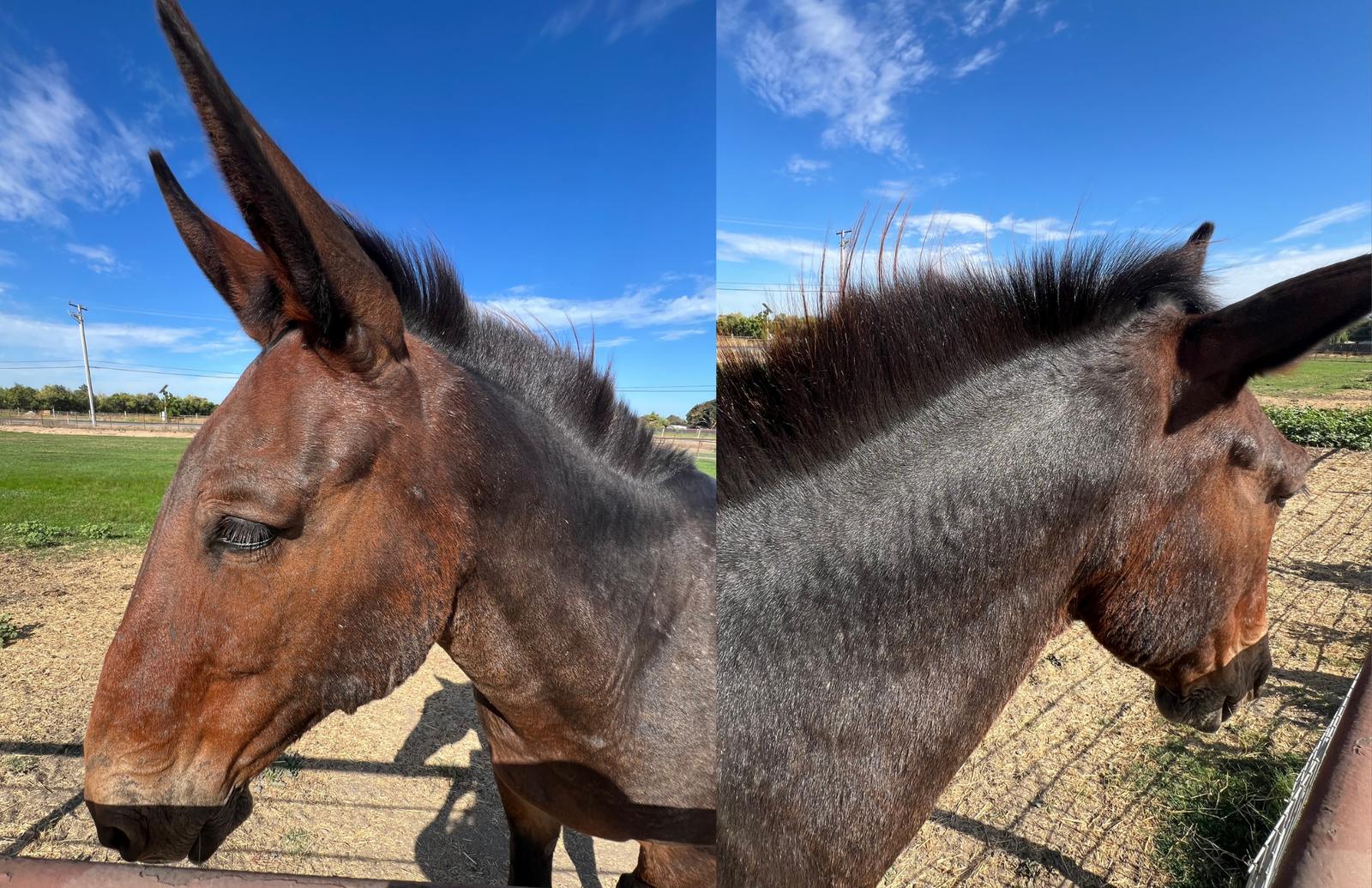
The other day, up the road from Lodi on my way to see some Arabians, I passed an auction house and something caught my eye out in the pasture. From a distance it looked like a horse — right legs, right build, standing quietly with a small group of Texas Longhorns. But when the animal turned and I saw the face, the face was a donkey’s. So there it was: a mule. And I pulled in.
He came right up to the fence. Ears about two feet long. A tail more like a cow’s than a horse’s. And that eye — nothing like the fire my Arabians carry. It was the patient donkey eye, the one that says, “I understand, and I’m waiting.” I stood there a while. He wasn’t for sale. He belonged to the auction owner himself, kept out with the longhorns as his own animal. That’s worth pausing on. A man who watches horses and mules pass through his ring every week chose to keep this one for himself. In the mule world, that tells you almost everything.
Because here’s what I’ve come to believe: a good mule is harder to find than a good horse. Horses are everywhere. Good mules are rare, and the people who have one tend not to let them go.
The stubborn myth
Ask most people about mules and the first word is “stubborn.” The second is usually “stupid.” Both are wrong, and they’ve been wrong for a long time.
Researchers at the Donkey Sanctuary in the UK ran mules, donkeys, horses, and dogs through problem-solving tests. The mules and donkeys were not only as clever as the dogs — they were more flexible in their thinking than either horses or dogs, which is exactly what “stubborn” is supposed to rule out.
What people call stubbornness is actually self-preservation. A mule won’t overload itself, won’t overheat itself, won’t step onto footing it doesn’t trust, and won’t be talked into something it has already decided is a bad idea. The University of Missouri Extension puts it plainly: when a mule is uncertain, it stops and thinks it over — and we call that stubborn. A horse, by contrast, can be ridden until it drops. Which of those two, honestly, is the smarter animal?
I’ve seen plenty of stubborn Quarter Horses in my day. Too many. Nobody writes them off as a species for it.
Why they don’t spook the way horses do
This is the part that matters most to me, and it’s the part most riders never really think through until they’re on the ground.
A horse is a flight animal. When something startles it, the response is built into the species — bolt first, look later. And a horse doesn’t just run forward. It moves sideways, in a microsecond, faster than your body can react. You’re either balanced in that saddle when it happens or you’re
not, and if you’re not, you’re in the dirt before you knew there was anything to be afraid of. That’s the truth of a spook, and it’s why so many older riders quietly stop riding.
Mules don’t work that way. From the donkey side, they inherit a strong sense of self preservation and a much weaker flight reflex. A government trail-riding guide from the U.S. Forest Service notes that when horses and mules startle, the mule is far more likely to freeze and assess than to bolt. Trainers who ride both say the same thing: a mule is more likely to stop and think, or plant its feet, than to launch sideways with a rider on its back.
That is not a small difference. That is the difference between a ride and an ambulance.
Sure-footed, on purpose
Their feet are smaller, more upright, more boxy than a horse’s — which is part of why they’re famously sure-footed on rough ground. But the other part is psychological. A mule looks at slick ground, a narrow trail, a bad piece of footing, and it appraises. It negotiates the spot carefully instead of trusting momentum. The British Mule Society describes a well-handled mule as “obliging, kind, patient, persevering, calm, tolerant, sensible, loyal, affectionate” — with, yes, a little pride and calculation thrown in. That sounds about right to me.
They’re also long-lived. Wikipedia’s summary, drawn from equine sources, notes mules are more patient, hardier, and longer-lived than horses. In good hands, a mule can carry a rider well into its 30s, and 40-year-old retirees are not unheard of. Try that with most horses.
The animal for the second half of life
I keep thinking about the friend I asked. A woman, a rider herself, and when I said, “Would you ever have a mule?” she said no. Flat out. No hesitation, no curiosity, no “tell me more.” I said, “Well, why not?” And she didn’t have a reason. Just no.
That’s what I want to press on, gently. Because when you get older — and I say this as somebody who is getting older, and who has ridden hot Arabians for a long time — the calculus changes. You’re not trying to prove anything on horseback anymore. What you want is an animal that will bring you home. An animal that thinks before it moves. An animal that won’t spin out from under you because a plastic bag drifted across the trail. An animal that will look at a bad situation and decide, on its own, that neither of you is going to die today.
That is a mule. That is exactly what a good mule is for.
The horse world has a habit of treating mules as a joke, or a downgrade, or something you settle for. It’s the opposite. A steady, well-trained riding mule is one of the safest, most useful animals a person can own, and the reason more people don’t own one has almost nothing to do with the animal. It has to do with vanity, and habit, and the long, tired myth that anything with long ears must be a lesser creature.
The rare good one
Which brings me back to the mule at the auction house.
He wasn’t for sale. He was the owner’s — a man who could have any animal that crossed his ring, and this was the one he kept. He was calm at the fence. He was gentle to a stranger. He stood in a pasture with longhorns like it was nothing. And he had that patient donkey eye, waiting, not measuring me for a fight.
You can find a nice horse without much trouble. Good horses are common enough. But a truly good mule — trained, sound, kind, sensible, safe under a rider — is a rare thing. The people who own them know it. That’s why they don’t come up for sale often. That’s why the good ones tend to live out their lives with the family who found them.
So no, I don’t think mules are stubborn. I don’t think they’re stupid. I think they’ve been misjudged for a couple of hundred years by people who mistook self-preservation for defiance and intelligence for laziness.
And I think if more of us — especially those of us who have loved horses for a lifetime and are starting to feel our years in the saddle — took an honest look at a good mule, we’d stop asking “would you ever?” and start asking, quietly, where do I find one.
They’re out there. Standing in a pasture next to some longhorns. Waiting patiently. Watching us with that steady eye, wondering when we’ll finally figure them out.