The Quiet End of the Ego Ranch
A ranch in the middle of nowhere is fine for about two weeks.
Then reality sets in.
I’ve been watching the listings lately — the sixteen-thousand-square-foot homes on six hundred acres, the drone footage sweeping over grass and gravel drives, the interiors staged like a magazine. They photograph beautifully. They sell a feeling. And I understand the feeling. I’ve lived on land my whole adult life, and I know exactly what pulls a buyer toward it.
But I also know what happens after the moving trucks leave.
The questions nobody asks on the walkthrough:
Where is your vet at two in the morning when a horse is down?
Where is your doctor when your back finally says no?
Who fixes the well when it goes out in July?
Who is going to run the place — really run it — when you decide you’d rather be reading a book than moving irrigation?
These are not romantic questions. They are the actual questions. And in the middle of nowhere, the answers are always the same: farther than you thought, more expensive than you planned, and harder to find than anyone warned you.
Ranch help, in particular, is not a want ad you post on Tuesday and fill by Friday. Good ranch help is a relationship built over years, and if the place is remote enough, there is no one nearby to build it with. You end up housing your help, feeding your help, and worrying about your help — which is a full job on top of the ranch itself.
The story I can’t stop thinking about
Not long ago I came across a property where the man of the house had a stroke, and his wife divorced him not long after. I don’t know the whole story, and I’m not going to pretend I do. But I’ve seen enough of these places to guess at some of it. The isolation. The weight of a house that big. The silence that stops feeling peaceful and starts feeling like a warning. The realization, somewhere around year three, that the dream was his and the work was hers.
I felt for both of them. That is not a story about bad people. That is a story about a piece of land that asked more than two human beings could give it, in a location where no one was close enough to help carry any of it.
Ego ranches are quietly going out of style
There was a time when the biggest house on the biggest piece of ground was the trophy. It signaled that you had arrived. That era is ending, and I don’t think it’s coming back. Unless you are a multi-billionaire with a compound in Montana and a staff of twenty, the enormous remote estate has stopped being aspirational and started being a burden with a view.
The taste has shifted. Buyers who have actually done it — the ones who bought the dream and lived the reality — are now looking for something else. Smaller. Closer in. Livable at seventy the way it was livable at fifty. Land you can steward without breaking yourself on it.
The Latte Ranch
Someone once called my place a “latte ranch,” and I’ve decided to take it as a compliment.
The acreage is real, and it’s all contiguous — one piece, not a patchwork. When you’re on it, you don’t see a neighbor. You don’t hear a road. To the east, on a clear morning, the snow-capped Sierras. To the west, the coastal hills and Mount Diablo. The full moon comes up over the pasture and the setting sun hits the old oak trees in a way that stops you where you’re standing. It is quiet the way people move to Montana to be quiet. It is private the way people build compounds to be private.
And it is two and a half minutes to Starbucks.
Two and a half minutes to Costco, Walgreens, CVS, and Macy’s. Two and a half minutes to the doctors, the lawyers, the dentist, the pharmacy, the good restaurants, and — yes — the fast food, if that is what the day calls for. The bridge into town crosses a beautiful river. The drive is short enough that you don’t dread it and pretty enough that you don’t mind it.
You get the oasis without paying the isolation tax.
A rare gem, and I know it
I live on what other people take vacations to find.
That’s the part I try not to lose sight of. People fly halfway across the world, book a lodge, drive hours off the highway, and pay a great deal of money for one week of what I get to walk out into every morning. The quiet. The light. The horses. The space to think. That is my ordinary Tuesday.
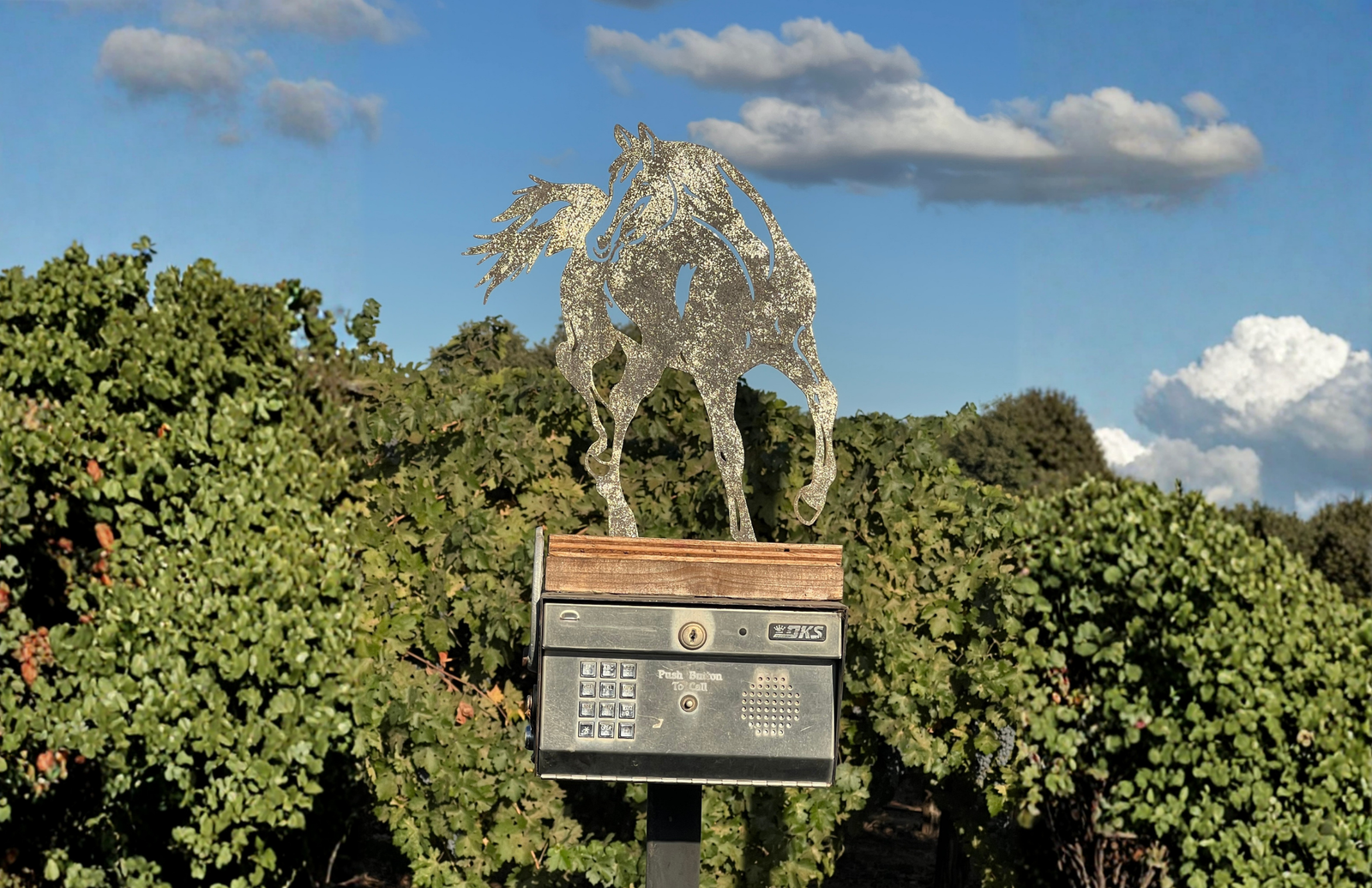
From the road, you wouldn’t even know what’s back here. There is a small sign with a horseshoe and a horse statue that lets you know you’re entering an equine facility, and that’s about it. No gates trying to impress anyone. No announcement. The place doesn’t advertise itself, and it never has.
It has never been on the market. Places like this almost never are.
Why residential ranches like this are in tight supply
Almost no one built these on purpose. Most of the true residential ranches — real acreage, real privacy, real quiet, but genuinely close to a working town — were assembled over generations by families who happened to be near a small city before the city grew toward them. You cannot manufacture the combination. Either the land is there and the town isn’t, or the town is there and the land has been chopped into subdivisions.
When one of these places does change hands, it is almost always because someone has aged out of it or is settling an estate. They don’t stay available long, and they don’t come back around often.
And when one does surface, what a serious buyer really wants is not another project. It’s a turnkey oasis — the fences already good, the barns already working, the systems already tested, the rhythms of the place already established. Somewhere you can step into and live in, not somewhere you have to build into being livable. That is the rarest version of all.
What I’d tell a buyer today
If you are in your fifties or sixties and you are dreaming of a ranch, do this before you sign anything:
Drive the route to the nearest emergency room. Time it honestly, in the dark, in the rain.
Ask the neighbors — if you can find any — who they call for ranch help, and how long that person has been available.
Sit on the property alone for a full day. Not a tour. A day. Notice what the silence feels like in the afternoon, and again at dusk.
Ask yourself who is going to run it when you don’t want to anymore. Not in theory. By name.
If the answers to those questions feel thin, the property is telling you something. Listen to it.
An honest closing
I love this land. I am thankful for it every morning. I know how rare it is — one of a kind, really — to have privacy and quiet and beauty and a town close enough that life still works when your body or your circumstances change. I know I’m living the thing other people are trying to book a week of.
I am not against big places. I am against big places bought on a feeling, in locations that punish the people who buy them, at a stage of life when the punishment lands the hardest.
The ego ranch had its run. What’s replacing it is something better — a place you can actually live in, on land you can actually steward, close enough to the world that the world can still reach you when you need it to.
That’s the shift. And I think it’s a good one.